
This post is for informational purposes only and is not a substitute for professional medical or mental health advice. If you have concerns about your child’s mental health, please consult your child’s pediatrician or a licensed mental health professional.
Worry is a normal part of childhood. But for some children, anxiety grows beyond ordinary worry into something that gets in the way of sleep, school, friendships, or daily life. If you’re trying to figure out how to help a child with anxiety, the good news is that there is a lot you can do at home — and a lot of it starts with how you respond.
This post covers how anxiety shows up at different ages, what to say and not say, calming tools that actually work, how to help without making anxiety worse, and when to call in professional support.
Signs of Anxiety in Kids by Age
Anxiety doesn’t always look like worry. Depending on the age, it can show up as anger, stomach aches, clinginess, or avoidance.
Toddlers and preschoolers (ages 2–5):
– Separation distress that doesn’t ease once the parent leaves
– Frequent stomach aches or headaches with no medical cause
– Meltdowns in new situations or around transitions
School-age children (ages 6–11):
– Avoiding school, activities, or social situations
– Repeated reassurance-seeking (“Will you be there? What if something bad happens?”)
– Physical complaints before challenging events
Tweens and teens (ages 12+):
– Withdrawing from friends or activities they used to enjoy
– Irritability, restlessness, or emotional outbursts
– Excessive worry about performance, grades, or what others think
Occasional anxiety about new things is completely typical. The concern is when anxiety is frequent, intense, or keeps a child from doing things that are normal for their age.
What to Say — and What Not to Say — to an Anxious Child
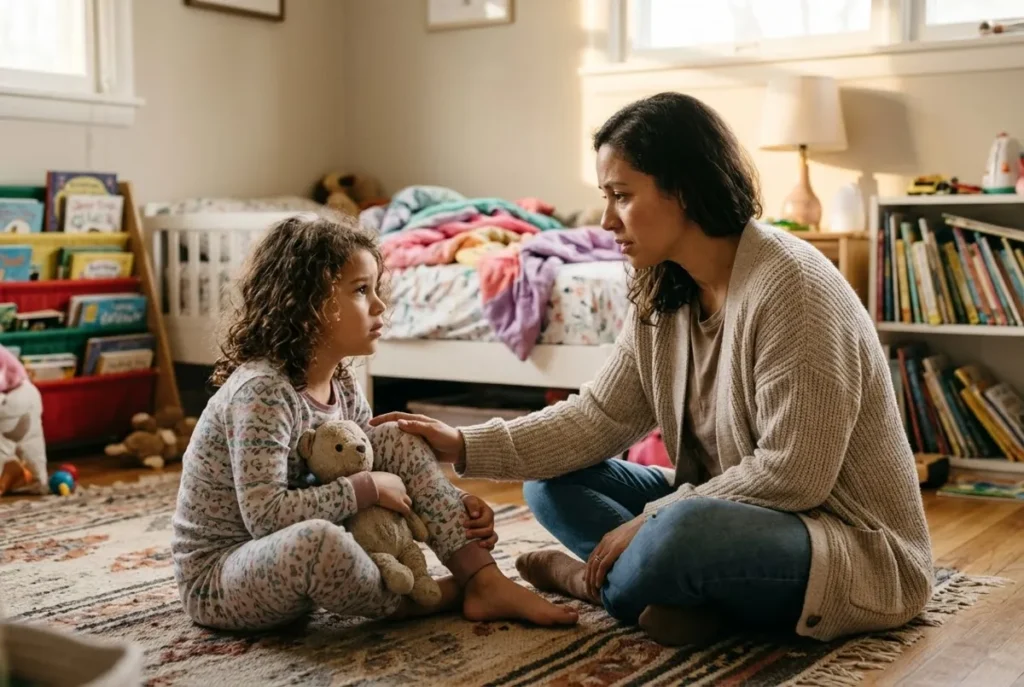
What parents say in an anxious moment matters more than most of us realize. Here are some common responses and better alternatives.
Instead of: “There’s nothing to worry about.”
Try: “I hear you. That does feel scary. Let’s think about what we can do.”
Instead of: “You’re fine — just go.”
Try: “I know this feels hard. I believe you can do it. I’ll be right here.”
Instead of: “Stop worrying — you’re making this worse.”
Try: “Worries are really uncomfortable. Let’s try something that helps your body feel calmer.”
Instead of: “I’ll stay if you want me to.” (when avoidance is the pattern)
Try: “I know you can handle this. I’ll see you in an hour.”
The goal is to validate the feeling without confirming the threat. You can acknowledge that something feels scary without agreeing that it is dangerous or that your child needs to avoid it.
How to Help a Child With Anxiety: Calming Tools That Work

Children need a toolkit of strategies they can practice before the anxious moment, so the tools are available when things get hard.
Slow breathing. A simple method: breathe in for four counts, hold for four, out for four. The extended exhale activates the body’s calming response. Practice it at neutral times, not only during anxiety.
Grounding (the 5-4-3-2-1 technique). Ask your child to name five things they can see, four they can feel, three they can hear, two they can smell, and one they can taste. This pulls attention to the present moment and out of the worried mind.
Worry time. Set aside ten minutes each day — same time, same place — where your child can tell all their worries. Outside that window, when a worry comes up, you can say, “That’s a good one for worry time.” This teaches the brain that worries have a place, but that place is not all day long.
Predictable routines. Anxious children do better when they know what to expect. A consistent after-school routine and a steady bedtime routine reduce transitions that feel uncertain.
Movement and play. Physical activity is one of the most effective natural tools for regulating the nervous system. Daily outdoor play, dancing, or any movement your child enjoys all help.
Helping Without Over-Accommodating
This is one of the hardest parts. When your child is anxious, every instinct says: take away whatever is causing the distress. But accommodation — repeatedly adjusting life to avoid the anxiety trigger — can make anxiety stronger over time.
The difference:
- Support: Sitting with your child before a hard drop-off and then leaving.
- Over-accommodation: Staying indefinitely every day to prevent crying.
- Support: Letting your child sleep with a nightlight.
- Over-accommodation: Sleeping in their room every night because they’ve never learned to manage bedtime worry alone.
Gentle encouragement toward the feared situation — with warmth, not force — is called graduated exposure, and it’s the basis of most effective anxiety treatment. You’re taking small steps together, not pushing your child into the deep end.
Building your child’s belief in their own ability to cope matters too. How to raise emotionally resilient kids has more on this.
Bedtime Worries: When Anxiety Spikes at Night
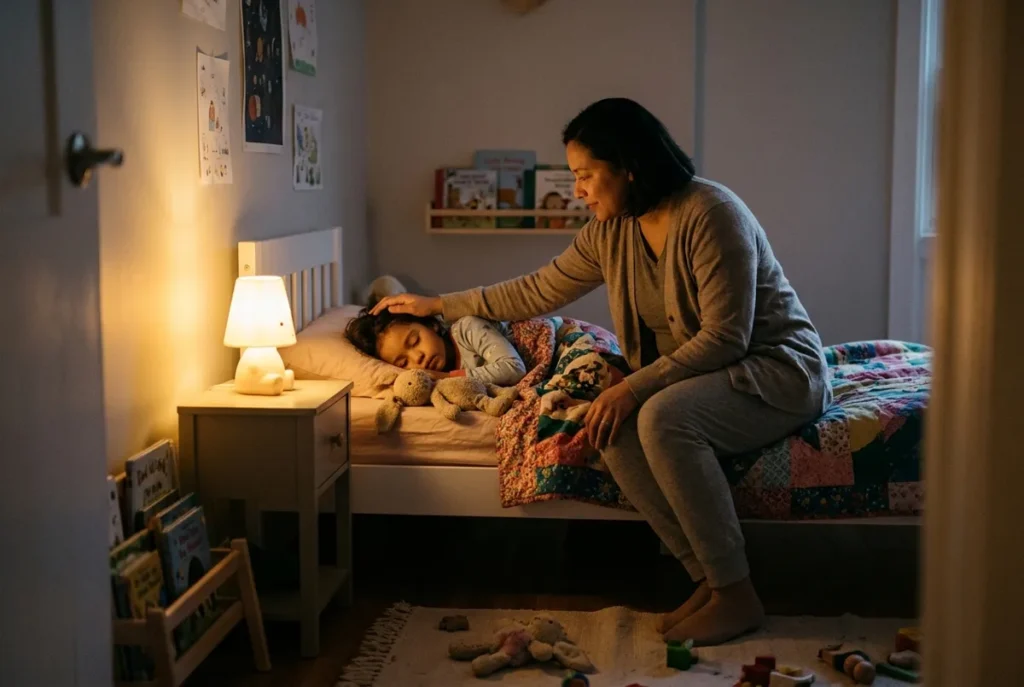
Bedtime is one of the most common times for anxiety to surface. The distractions of the day fall away, the room gets quiet, and the brain gets busy.
A few things that help:
- A consistent, calming routine. The same sequence each night — bath, pajamas, reading, quiet — signals safety to the nervous system.
- A “worry dump” before bed. Keep a small notebook by the bed. Invite your child to write or draw their worries and set them aside for the night.
- Limit reassurance-seeking. A calm, once-only answer works better than re-answering every repeated “Are you sure?” Try: “I already answered that one, and I know you can handle the night.”
- Prayer before sleep. Many children find it calming to give their worries somewhere to go. Bedtime prayers for kids has prayers specifically for children who feel anxious or afraid at night.
Bringing Faith Into the Picture
Faith can be a genuine source of comfort for anxious children when it’s offered gently, not used to dismiss worry.
Philippians 4:6–7 (KJV): “Be careful for nothing; but in every thing by prayer and supplication with thanksgiving let your requests be made known unto God. And the peace of God, which passeth all understanding, shall keep your hearts and minds through Christ Jesus.”
1 Peter 5:7 (KJV): “Casting all your care upon him; for he careth for you.”
Both of these passages acknowledge that care and worry are real — and they offer somewhere to bring them. You can pray with your child, naming the worry specifically and asking God for peace. This does not replace professional care when it is needed, but for many children it becomes a meaningful part of their calming toolkit.
One caution: telling an anxious child to “just pray and trust God” without also teaching practical coping skills can leave them feeling like their faith isn’t strong enough when worry returns. Faith and tools work together. For more on raising children with both warmth and structure, see gentle Christian parenting.
When to Seek Professional Help
Parental support goes a long way, but some situations call for professional care. Talk to your child’s pediatrician if anxiety is consistently interfering with eating, sleeping, school, or friendships, or if you’re unsure whether what you’re seeing is typical development.
Seek a licensed mental health professional if anxiety is not improving despite consistent support, is growing more severe, or is spreading to new situations.
Seek urgent help immediately if your child expresses thoughts of self-harm or suicide. In the United States, call or text 988 (the Suicide and Crisis Lifeline) or go to your nearest emergency room.
There is no shame in getting professional support. For many children, a course of therapy — particularly Cognitive Behavioral Therapy (CBT) — makes an enormous difference.
Frequently Asked Questions
How do I know if my child’s anxiety is serious?
Occasional worry is normal. When anxiety consistently keeps your child from age-appropriate things — school, friendships, sleeping alone — it’s worth consulting a professional.
Should I tell my child they have anxiety?
Many children feel relief when what they’re experiencing has a name. Use age-appropriate language: “Your brain sends worry signals that are bigger than what the situation needs. We can learn to calm those signals.”
Will my child grow out of it?
Some children do. Some don’t, or the anxiety shifts to new areas as they grow. Early support tends to prevent anxiety from becoming more entrenched.
What if my child refuses to try calming tools?
Practice the tools at calm moments, not in the middle of an anxious episode. A breathing exercise feels less threatening when learned during a quiet game than when introduced mid-meltdown.
Is my parenting causing my child’s anxiety?
Anxiety has many contributing factors, including temperament, biology, and life experiences. Parental responses can help or inadvertently strengthen it — which is why learning to respond helpfully matters. But a child experiencing anxiety is not a sign of bad parenting.
Final Thoughts
Helping an anxious child is slow, repetitive work — and it matters deeply. When you stay calm in their storm, name their feelings without amplifying them, and gently lead them toward what they fear, you are teaching them they are more capable than their worry says. That lesson stays. You don’t have to get it right every time. You just have to keep showing up.


Pingback: Yelling at Kids: What It Does to Them and How to Stop